

Why Your Teen Won't Talk to You: Even When You Say They Can Tell You Anything
You find out something happened with your teenager.
The school calls.
Another parent mentions it.
Or maybe one of their friends already knows.
And you're standing there thinking:
Wait. Why didn't you tell me?
Then comes the teenage answer that somehow answers absolutely nothing.
“I don't know.”
More...
Now you're confused because you KNOW you've told them:
“You can always talk to me.”
And you meant it.
You want your teenager to come to you.
You want to know what's happening in their life.
You want them to know that when something goes wrong, you're there.
So if you've been wondering why your teen won't talk to you, I want you to consider a question that may be a little different from the one you've been asking.
What if your teenager knows they're allowed to talk to you...
but they aren't completely sure what they're going to experience when they do?
Because those aren't always the same thing.
Your Teen Probably Heard You
Let's get this out of the way first.
Your teenager probably knows you've said they can talk to you.
Baby, they heard you the first 37 times.
The issue may not be whether you've given them permission.
The issue may be what they've learned from actually using that permission.
Think about the people in your own life.
There are probably people you technically could tell something to.
But you're not going to.
Maybe they panic.
Maybe they tell everybody.
Maybe they start solving the problem before you finish explaining it.
Maybe they hit you with an “I told you so.”
Or maybe you simply don't have the energy for their reaction today.
You can love someone and still think:
Yeah...I'm not calling her with this.
Your teenager can make that calculation too.
That's why one of the most important distinctions we can make as parents is this:
Permission isn't the same thing as emotional safety.
“You can tell me anything” is permission.
What happens when they actually tell you?
That's where safety gets tested.
Your Teen Is Collecting Evidence About Your Relationship
We tend to experience ourselves through our intentions.
I was trying to help.
I was protecting them.
I was trying to understand what happened.
And you probably were.
But your teenager experiences the interaction from the other side.
Maybe they told you they failed a test and before they finished explaining, you started talking about how much time they spend on their phone.
Maybe somebody hurt their feelings and your first response was:
“I told you that person wasn't your friend.”
Were you right?
Maybe.
And listen, I understand the satisfaction of everybody finally catching up to something you already knew.
But they weren't necessarily coming to you because they needed confirmation that Mom had correctly predicted the situation.
They were hurting.
Maybe they started telling you what happened at a friend's house and suddenly you're asking:
Who was there?
What time?
Whose house?
Was the mother home?
Who drove?
Why were you there?
You're thinking:
I'm trying to understand.
They're experiencing:
I am being interrogated.
Neither experience automatically makes either person wrong.
But it does mean intent and experience aren't always identical.
And that's worth paying attention to.
They May Remember Conversations You Forgot
Parents sometimes look for one major event.
“When did my teenager stop talking to me?”
But relationships don't always change because of one dramatic conversation.
Sometimes it's little moments.
Regular Tuesday-night stuff.
One lecture here.
One “I told you so” there.
One moment where something vulnerable got brought back up during another argument.
One time you told someone else something they thought was private.
One conversation where your fear came out sounding like anger.
None of those automatically make you a terrible parent.
Welcome to parenting.
We've all had moments we wish we could replay differently.
But small experiences can become patterns.
And eventually your teenager may start editing.
They tell you part of the story.
They leave out the piece they think will make you mad.
They wait until the problem is already handled.
Or they decide:
I knew I shouldn't have said anything.
That sentence matters.
Because the next time something happens, they're not starting from zero.
They're remembering.
Emotional Safety Does NOT Mean Your Teen Gets to Do Whatever They Want
Now I already know somebody is thinking:
So I'm supposed to smile while my teenager does whatever they want because I don't want them to feel uncomfortable?
No.
Nobody is taking your parent card.
You can have rules.
You can have boundaries.
You can say no.
You can give consequences.
Your teenager can be mad at you.
They'll survive.
Emotional safety does not mean freedom from accountability.
It means accountability doesn't require sacrificing the relationship.
Your teenager can know:
My mother is going to hold me accountable.
AND:
My mother is someone I can tell the truth to.
We want both.
You can say:
“Thank you for telling me. We're still going to have to deal with what happened.”
Both things can exist in the same conversation.
Sometimes Your Teen Is Trying to Manage Your Reaction
This one can pinch a little.
Sometimes your teenager is already dealing with the problem...
and before they tell you, they're thinking about whether they're going to have to deal with your emotions too.
“If I tell Mom, she's going to freak out.”
“If I tell Dad, he's going to start yelling.”
“If I tell her, she's going to worry herself sick.”
“If I tell him, he's calling somebody before I finish the story.”
That doesn't mean you're not allowed to have feelings.
You're human.
You're their parent.
Of course some things are going to scare you, frustrate you, disappoint you, or make you want to fix everything immediately.
The question is:
Who has to manage those emotions in the moment?
Because if your teenager is already overwhelmed and now they have to calm you down too...
they may decide not to invite you into the situation next time.
Sometimes the most emotionally intelligent response isn't having the perfect thing to say.
It's being able to say:
“Okay. Let me make sure I understand what you're telling me.”
And letting them finish.
“But They Tell Their Friends EVERYTHING”
Oh, this one gets parents.
You ask:
“How was school?”
“Fine.”
“What happened?”
“Nothing.”
“Anything interesting?”
“No.”
Apparently your teenager spent eight hours in a building with hundreds of other people and NOTHING occurred.
Then you hear them talking to a friend...
and suddenly this child has details, backstory, character development, timestamps, and a complete emotional analysis.
And underneath the irritation can be something much softer:
Why do they get that part of you and I don't?
That's real.
But their friend has something you don't.
Less power over what happens next.
Their friend can't ground them.
Their friend isn't making the family rules.
Their friend isn't deciding the consequence.
Their friend may not immediately turn their confession into a lesson.
That makes vulnerability with a friend different from vulnerability with a parent.
Your job isn't to compete with their friends.
Please don't.
They need friends.
And they need you to be their parent.
But understanding why telling you might feel riskier helps you respond differently when they take that risk.

“Can I Tell You Something...But Don't Get Mad?”
That sentence tells us so much.
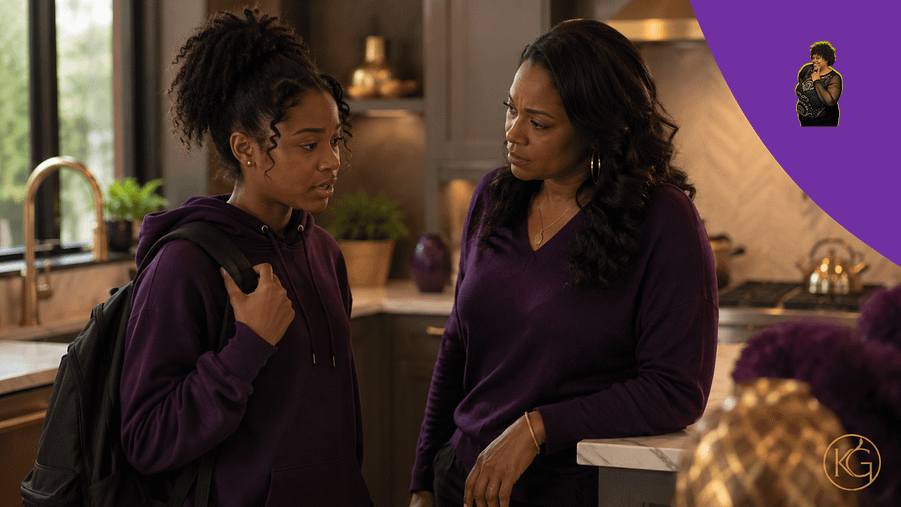
Your teenager comes into the kitchen.
Or your bedroom.
Or starts talking in the car while staring straight ahead because apparently eye contact would make the entire conversation impossible.
And they say:
“Can I tell you something?”
Then:
“But are you gonna get mad?”
Before you immediately say, “Why would I get mad?” hear what they may actually be asking.
Is it safe for me to finish this conversation?
Because your teenager isn't necessarily making that decision from scratch.
They're remembering you.
Your face.
Your tone.
Whether you listened.
Whether you interrupted.
Whether you immediately corrected.
Whether something they told you privately became ammunition in another argument.
Whether you made the problem bigger.
Whether you helped them feel like they could handle it.
That's the part I don't want us to miss.
Keisha Reveal™
Your teenager isn't only deciding whether to tell you something. They're remembering what happened the last time they did.
And no, that doesn't mean you need to start replaying every parenting mistake you've ever made.
That's not useful.
You have gotten things wrong.
So have I.
You have also probably gotten a whole lot right.
The opportunity isn't perfection.
The opportunity is the next interaction.
Stop Trying So Hard to Get Your Teen to Talk
This may sound backwards in an article about why your teen won't talk to you, but stop making talking the goal.
When we're desperate for information, communication can start sounding like an investigation.
What's wrong?
Nothing.
Are you sure?
Yes.
Did something happen?
No.
Was it your friends?
No.
School?
No.
Someone you're dating?
MOM!
Sometimes your teenager isn't ready.
Sometimes they don't know how they feel yet.
Sometimes they need time.
And sometimes growing up means there will be parts of their inner world that belong to them.
Closeness does not mean access to everything.
Instead of making:
“My teenager needs to tell me everything”
the goal, try:
“When my teenager chooses to tell me something, I want them to experience me as someone who can handle the truth.”
That's something you can control.
One Thing to Practice This Week
I don't want to give you twelve communication techniques to remember.
Try one thing:
Let your first response make room for the rest of the story.
Before correcting.
Before solving.
Before giving the consequence.
Before reminding them that you warned them.
Try:
“Okay. Tell me what happened.”
“I'm listening.”
“Thank you for telling me.”
“And then what happened?”
You can parent after you've listened.
You can set the boundary after you've understood.
You can decide what happens next.
But correction does not always have to occupy the first thirty seconds of vulnerability.
And if you need a moment?
Take it.
“I want to respond to this well. Give me a second.”
I'd rather you take a minute than say something in ten seconds that affects the next ten conversations.
Keisha Principle™
Every conversation teaches your teenager whether it's safe to have the next one.
Don't Miss the Small Invitations
Your teenager may never sit down and announce:
“Mother, I would now like to engage in an emotionally vulnerable conversation.”
That's usually not how teenagers work.
They may walk into your room at 11:47 at night and start talking about something random.
They may suddenly mention something while you're driving.
They may text you from upstairs.
They may tell you some long story about people you don't know and you're sitting there trying desperately to remember who everybody is.
Those moments matter.
Don't miss the invitation because it didn't look like the conversation you imagined.
And please don't finish this article and immediately go ask:
“Why don't you feel emotionally safe talking to me?”
Please don't do that either.
You don't need to force a big relationship conversation tonight.
Pay attention to the next small opening.
When your teenager gives you a piece of their world...
notice what you do with it.
You don't need them to hand you everything today.
Show them what happens when they trust you with the piece they gave you.
That's how emotional safety grows.
Not because you told them they could talk to you.
Because over time, you've shown them what happens when they do.

Continue the Journey
If communication with your teenager feels harder than it used to, Bridging the Teen Gap will help you understand what's happening underneath the power struggles and begin rebuilding connection in everyday moments.
Get Bridging the Teen Gap: https://keishagolder.com/amzn-bridging-the-teen-gap/
And continue with the next lesson in the Emotionally Intelligent Teen Method™:
Why Your Teen Stops Talking Before the Argument Even Starts
Because the next thing we're looking at is how emotional safety gets built long before your teenager ever says:
“Mom, we need to talk.”
FAQ Opportunities
Why won't my teenager talk to me anymore?
A teenager may talk less for several reasons, including increasing independence, fear of judgment or consequences, difficulty explaining what they're feeling, or previous experiences with difficult conversations. Instead of immediately forcing communication, pay attention to what happens when they do share something.
How do I get my teenager to open up to me?
Rather than trying to make your teenager open up, focus on becoming someone who can receive what they share. Listen before correcting, avoid immediately interrogating or solving, and let your first response make room for the rest of their story.
Does emotional safety mean I shouldn't discipline my teenager?
No. Emotional safety and accountability can exist together. You can have boundaries, consequences, expectations, and disagreement while still protecting your teenager's dignity and your connection with them.
Why does my teenager tell their friends everything but not me?
Friends usually have less authority over what happens next. Telling a parent can carry a greater perceived risk because a parent's reaction may lead to rules, consequences, intervention, or advice. Understanding that difference can help you respond more intentionally when your teenager does open up.